Businesses operating in Ukraine may need various types of business permits and regulatory documents. These include licenses, permits, official opinions, declarations, and certificates. It is also important to understand that the requirements and lists of applicable documents are constantly changing. Some document requirements are abolished, while new ones are introduced through legislation.
Understanding which permits and regulatory documents a business needs, where to obtain them, and when to apply requires navigating a substantial amount of information. The process can be a real maze: even one additional KVED business activity code may trigger a licensing requirement, while failing to obtain a required document can result in fines or suspension of business activities.
That is why we are launching a series of articles outlining the main types of business permits and regulatory documents required to operate in Ukraine. Obtaining the necessary documents is an important step after company registration, whether you establish a limited liability company (LLC) or register as a sole proprietor.
Key legislative acts governing business permits in Ukraine include:
- The Law of Ukraine “On Licensing of Types of Economic Activity” No. 222-VIII, which establishes the exhaustive list of business activities requiring a license.
- The Law of Ukraine “On the List of Documents of a Permitting Nature in the Field of Economic Activity” No. 3392-VI, which establishes the official list of permits and other regulatory documents that public authorities are entitled to require.
- The Law of Ukraine “On the Permitting System in the Field of Economic Activity” No. 2806-IV, which governs the general principles for issuing permits.
- Resolution of the Cabinet of Ministers of Ukraine No. 1118 of October 27, 2023, “Certain Issues Relating to Economic Activities in the Field of Overseas Employment Mediation.”
The key point is that public authorities are not entitled to require documents that are not included in the official list.
Main Categories of Business Permits and Regulatory Documents
1. Licenses
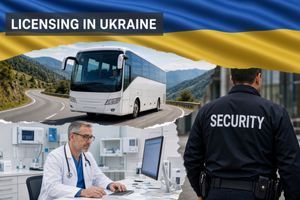
Licenses are required for certain regulated business activities, including alcohol sales and tobacco sales, medical practice, pharmaceutical activities, passenger and freight transportation, construction, financial services, security services, weapons manufacturing, and other activities specified by law. Licenses are issued by the relevant licensing authority, such as the Ministry of Economy, the Ministry of Health, or the State Production and Consumer Service, depending on the activity. The application review period is generally up to 10 business days.
2. Permits and Official Opinions
Permits and official opinions are often required for manufacturing, construction, and food service businesses. Examples include a special water-use permit, an environmental impact assessment opinion, and a permit for high-risk work, among other documents.
3. Declarations
In recent years, certain permit procedures have been replaced by a declaratory system. Instead of obtaining a separate permit, an entrepreneur may be required to notify the state of the commencement of business activities, for example through Diia or an Administrative Services Centre (CNAP). This applies to certain occupational health and safety activities, some types of trade and services, and overseas employment services.
4. Special Permits and Certificates
These documents may be required for foreign economic activities, including the export or import of certain goods, fire safety compliance, and sanitary and epidemiological compliance. For example, food businesses may need to register their facilities as market operator facilities. Other requirements depend on the specific business activity.
Business permit procedures in Ukraine are increasingly being digitized, allowing many applications and documents to be submitted electronically. The introduction of martial law in the country has also influenced the way certain administrative procedures are carried out.
Practical Tips for Obtaining Business Permits in Ukraine
- Before registering your business, check your KVED business activity code with the relevant licensing authority or against the official list to determine whether your planned activity requires a license.
- If you need a permit, use Diia or an Administrative Services Centre (CNAP). Many applications can now be submitted online using an electronic signature.
- Avoid collecting unnecessary documents “just in case.” The law expressly prohibits public authorities from requiring documents that are not included in the official list.
- Keep track of legislative changes whenever possible. Lists of permits and licensing requirements are regularly updated.
- If your business operates in a regulated sector, such as healthcare, alcohol sales, construction, or foreign trade, and requires permits or licenses, consult a legal professional. Even a single error in your application package can lead to rejection or delays in obtaining the required authorization.
- Keep all electronic confirmations of application submissions and supporting documents, as they may be needed during inspections.
As mentioned above, the business permitting system in Ukraine is gradually becoming simpler through digitalization, but it remains complex and fragmented. The number of permits, government authorities responsible for issuing them, and requirements that vary from one situation to another make it difficult even for experienced entrepreneurs to manage everything independently. In our upcoming articles, we will examine specific types of licenses and permits in greater detail, providing step-by-step guidance and outlining the applicable requirements.
In any case, one principle remains unchanged: it is better to carefully determine which permits and regulatory documents your business needs from the outset than to spend time, money, and effort later dealing with fines, official enforcement orders, or even a temporary suspension of business activities. Proper preparation at the start helps save resources and allows you to focus on growing your business with greater confidence.